API 610 Centrifugal Pump Selection for Boiler Feed Service
A comprehensive comparative guide to selecting between Overhung (OH2), Axially Split Between-Bearings (BB3), and Double-Casing Barrel (BB5) centrifugal feed pumps based on operating pressure and thermal cycling severity.
1. The Critical Role of Pump Architecture in Boiler Reliability
Boiler feedwater service combines extreme hydraulic pressures (often exceeding 150 bar), high operating temperatures (105°C to 180°C), and continuous thermodynamic service factors. The American Petroleum Institute (API) Standard 610 (ISO 13709) provides the global benchmark for heavy-duty centrifugal machinery.
Selecting the wrong casing architecture results in shaft deflection, mechanical seal failures from thermal casing distortion, interstage leakage, or catastrophic casing rupture during rapid cold startup thermal shocks.
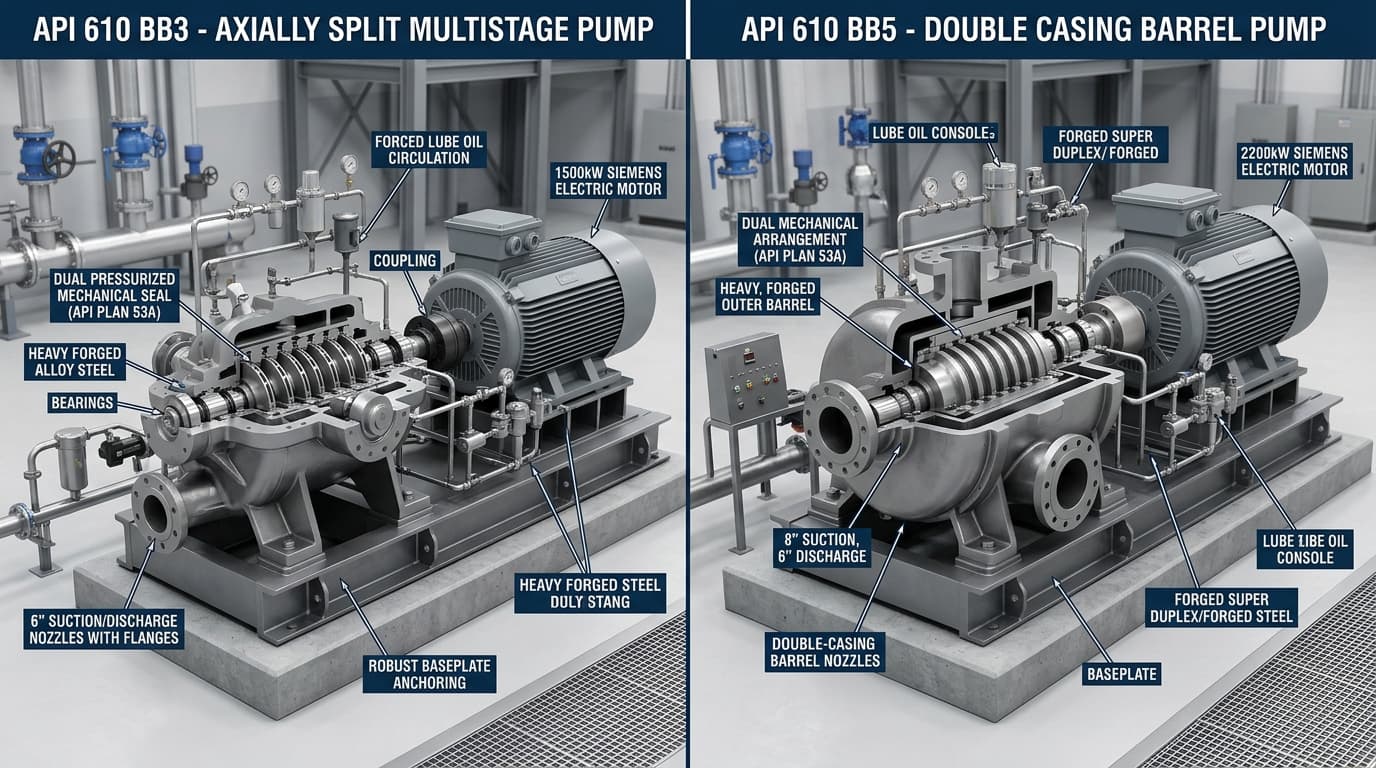
2. Detailed Comparison: OH2 vs BB3 vs BB5 Configurations
API 610 OH2: Overhung Single-Stage Centerline-MountedP < 25 bar
Design Features: The impeller is cantilevered over bearings mounted in a separate bearing frame. The casing is centerline-supported to accommodate thermal growth without distorting shaft alignment.
Ideal Application: Low-pressure packaged firetube boilers (operating under 15 bar), auxiliary heating boilers, and condensate booster applications where differential head requirements are modest.
API 610 BB3: Axially Split Multistage Between-Bearings25 bar ≤ P ≤ 120 bar
Design Features: Impellers are arranged between bearing housings, eliminating cantilever deflection. The casing splits horizontally along the shaft centerline, allowing rapid field maintenance and inspection without disturbing suction and discharge piping nozzles.
Opposed Impeller Advantage: Staging impellers back-to-back balances axial hydraulic thrust inherently, minimizing the load transferred to thrust bearings.
Ideal Application: Cogeneration facilities, industrial chemical plant watertube boilers, and waste-heat recovery steam generators (HRSGs).
API 610 BB5: Double-Casing Radially Split Barrel MultistageP > 120 bar (up to 350+ bar)
Design Features: Features an inner hydraulic bundle encased within a forged outer cylindrical pressure barrel. The radial split design eliminates long horizontal gasketed joints, providing maximum containment integrity against extreme pressures.
Thermal Shock Resistance: Symmetrical barrel casing expands uniformly during sudden cold plant starts or hot standby transitions, eliminating thermal bowing.
Ideal Application: Supercritical and ultra-supercritical coal/gas power stations, combined-cycle gas turbine high-pressure loops, and high-pressure desalination facilities.
3. Selection Decision Flowchart
Ready to Size Your Machine?
Input your boiler steam rate and operating pressure to receive instant API 610 casing recommendations.