Boiler Feed Tank & Deaerator Storage Sizing Principles
A comprehensive engineering guide on determining effective liquid retention time, total shell capacity, surge allowances, and static elevation requirements per ASME and Hydraulic Institute standards.
Size your feed tank alongside pump head in real-time
Calculate mass flow and required deaerator capacity using our interactive engineering suite.
1. The Functional Role of the Feedwater Storage Vessel
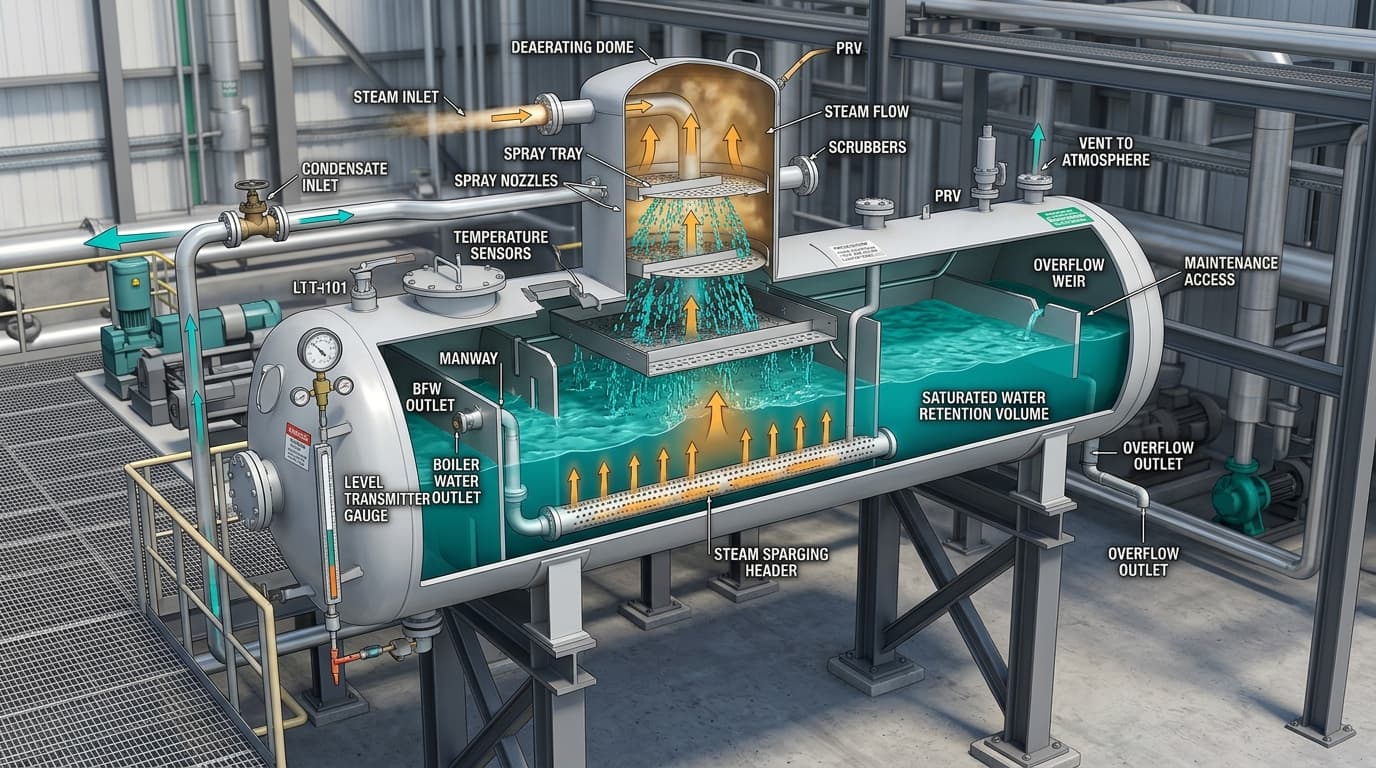
In steam generation plant design, the boiler feed tank (often integrated into the lower storage vessel of a thermal deaerator) serves three critical operational functions:
- Hydraulic Decoupling & Surge Buffer: It decouples intermittent condensate return surges and cold makeup water treatment flows from the continuous, highly regulated demands of high-pressure boiler feed pumps.
- Deaeration & Thermal Conditioning: By preheating feedwater to saturation temperature using low-pressure stripping steam, it liberates dissolved oxygen (O₂) and free carbon dioxide (CO₂), keeping dissolved oxygen below 5 to 7 ppb per ASME guidelines to eliminate boiler tube pitting.
- NPSH Head Generation: It provides elevated liquid static head directly above the feed pump suction nozzles, creating the positive hydraulic margin required to prevent impeller cavitation flashing.
2. The 10 to 20 Minute Retention Rule Derivation
The primary sizing metric for effective tank storage volume is retention time at Maximum Continuous Rating (MCR):
Selection of retention duration depends on plant architecture and feedwater makeup dynamics:
| Boiler Category | Recommended Retention | Engineering Justification |
|---|---|---|
| Packaged Firetube Boilers | 10 to 12 Minutes | Large internal water volume acts as an inherent thermal buffer against rapid steam demand swings. |
| Industrial Watertube Boilers | 15 to 18 Minutes | Low drum water hold-up time requires reliable storage to handle modulating firing rates without level trips. |
| Biomass & Combined-Cycle (CCGT) | 20 Minutes | Frequent condensate batch returns and slow demineralized makeup system response times mandate 20 min capacity. |
3. Shell Volume Breakdown: The 60% Usable Rule
It is a catastrophic design mistake to size the physical vessel shell equal to the calculated effective volume. Effective volume represents only the usable operating band between the Low-Water Level Trip and High-Water Overflow:
A standard industrial horizontal cylindrical vessel allocates internal cross-sectional volume into three distinct zones:
- Upper Vapor & Steam Surge Disengagement Space (20%): Provides adequate vapor-liquid separation surface area to prevent steam entrainment and liquid carryover into deaerator vent condensers during sudden condensate returns.
- Usable Operating Band (60%): The active working volume that accommodates boiler firing cycles, makeup water valve modulation, and transient level variations.
- Low-Level Submerged Buffer (20%): The liquid column maintained below the low-water alarm setting. This reserve ensures that vortexing does not ingest steam or non-condensable gas bubbles into the pump downcomer, which would instantly destroy feed pump mechanical seals.
4. Vessel Geometry: Optimizing the Length-to-Diameter (L/D) Ratio
Most industrial boiler feed tanks and deaerators are designed as horizontal cylindrical pressure vessels with 2:1 semi-ellipsoidal or torispherical dished heads. Sizing geometry balances floor footprint, shell wall thickness, and liquid surface area.
The industry standard aspect ratio is an $L/D$ between 3.0:1 and 4.0:1 (typically 3.5:1). This aspect ratio ensures maximum horizontal surface area for oxygen stripping while maintaining reasonable structural beam stiffness across saddle supports.
5. Frequently Asked Questions (FAQ)
What is the standard retention time for a boiler feed tank?
Standard industrial practice specifies between 10 and 20 minutes of effective water storage calculated at the boiler’s Maximum Continuous Rating (MCR). Packaged firetube boilers operating with steady steam demand can operate reliably on a 10–12 minute buffer, whereas rapid-cycling industrial watertube boilers, biomass plants, and power utility installations require 15 to 20 minutes of reserve storage.
Why must gross tank volume be larger than calculated effective volume?
Effective volume accounts only for the usable drawdown liquid between the high-water alarm and the low-water trip level. Gross internal shell volume is typically sized as V_gross = V_effective / 0.60 to preserve a 20% top vapor disengagement and steam surge cushion, plus a 20% minimum submerged buffer at the bottom to prevent vortexing and air ingestion into pump suction lines.
How does deaerator elevation directly protect against pump cavitation?
Because water in a thermal deaerator is kept at boiling saturation temperature, its surface pressure equals its vapor pressure. In the NPSHa equation, (P_suction - P_vapor) / (ρ × g) cancels to zero. The vertical liquid elevation column above the pump centerline is the sole driving force ensuring NPSHa exceeds the pump’s NPSHr.
Continue Exploring Hydraulic Sizing
Learn how deaerator elevation directly interacts with suction NPSH margin and anti-cavitation piping design.